By Annabelle Lee
*This article was published in “These Streets Have Stories” – a zine produced out of the Hitting The Pavement: Riwayat 3 Tun writing programme where participants wrote from their experiences exploring Jaan Tun Perak, Jalan Tun HS Lee and Jalan Tun Tan Cheng Lock in Kuala Lumpur. The zine was launched on May 25 at the 2024 Kuala Lumpur International Book Fair.
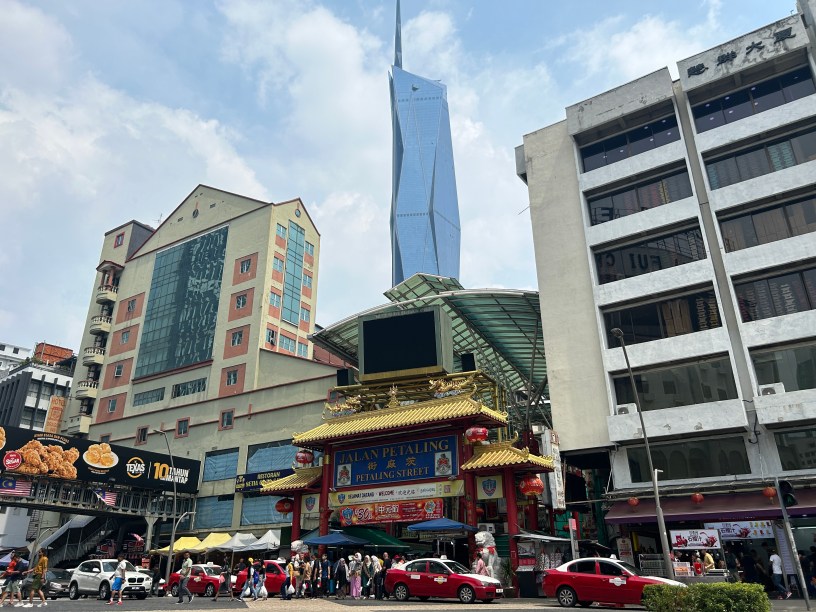
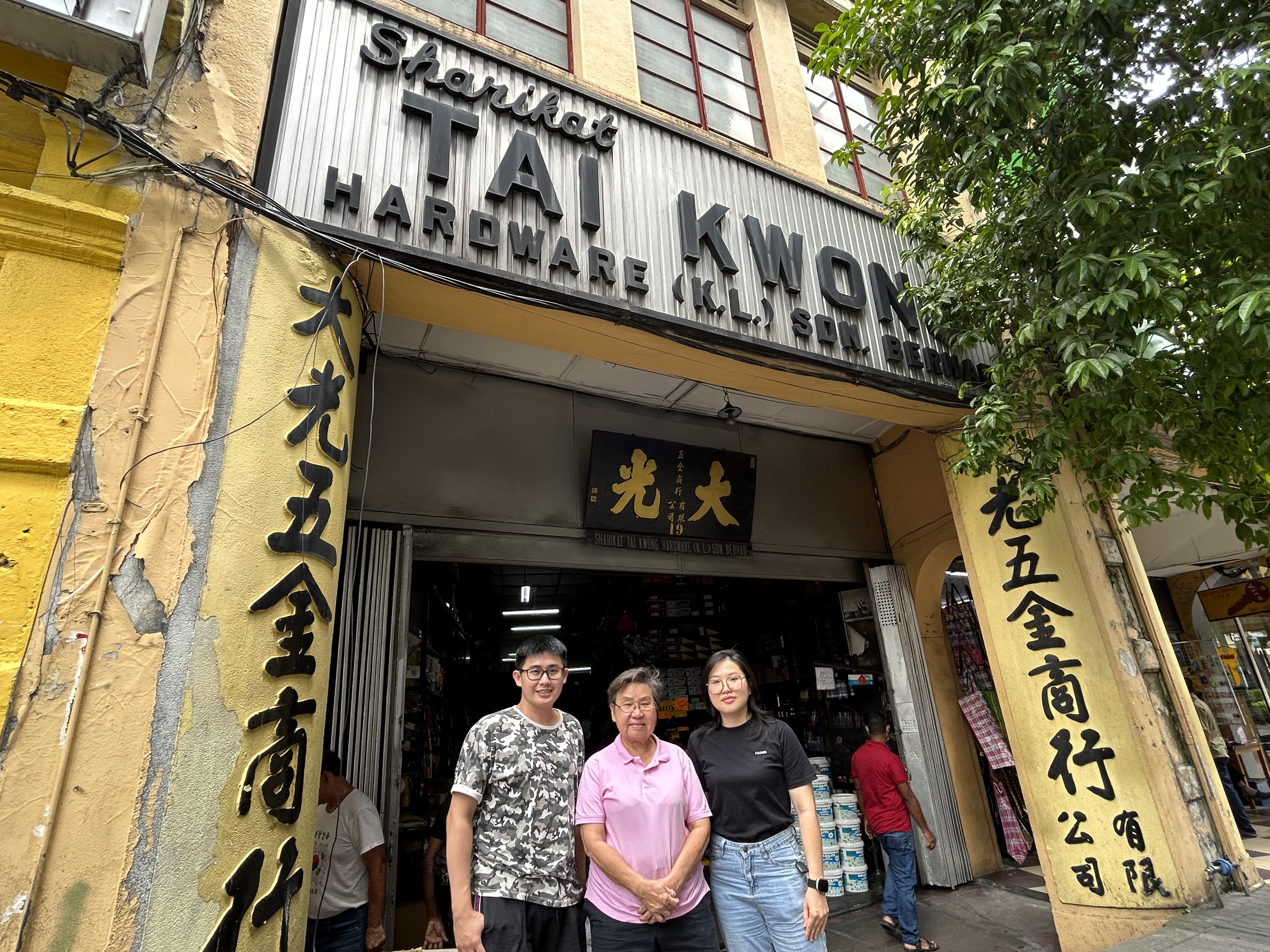
Located at the intersection of Jalan Tun Tan Cheng Lock and Jalan Petaling, the dusty canary yellow shopfront of Tai Kwong hardware store can appear muted amidst noisy downtown Kuala Lumpur.
Only upon closer inspection does one notice signatures of the past. Like the three-dimensional, cursive “sharikat” on the signboard (instead of the more contemporary “syarikat”). Above its shopfront windows, “大光五金” – pronounced tai kwong em gam in Cantonese – is engraved into the plaster in bold, black fonts. To be read from right to left in a traditional Chinese style.
Its restrained and elegant Early Modern façade stands in sharp contrast to the inside, where handbuilt shelves extend floor to ceiling and have gobbled up the walls on all four floors. But as one of the fundamental rules of physics dictates, there can never be enough storage space. And so bulging plastic bags hang off shelves.
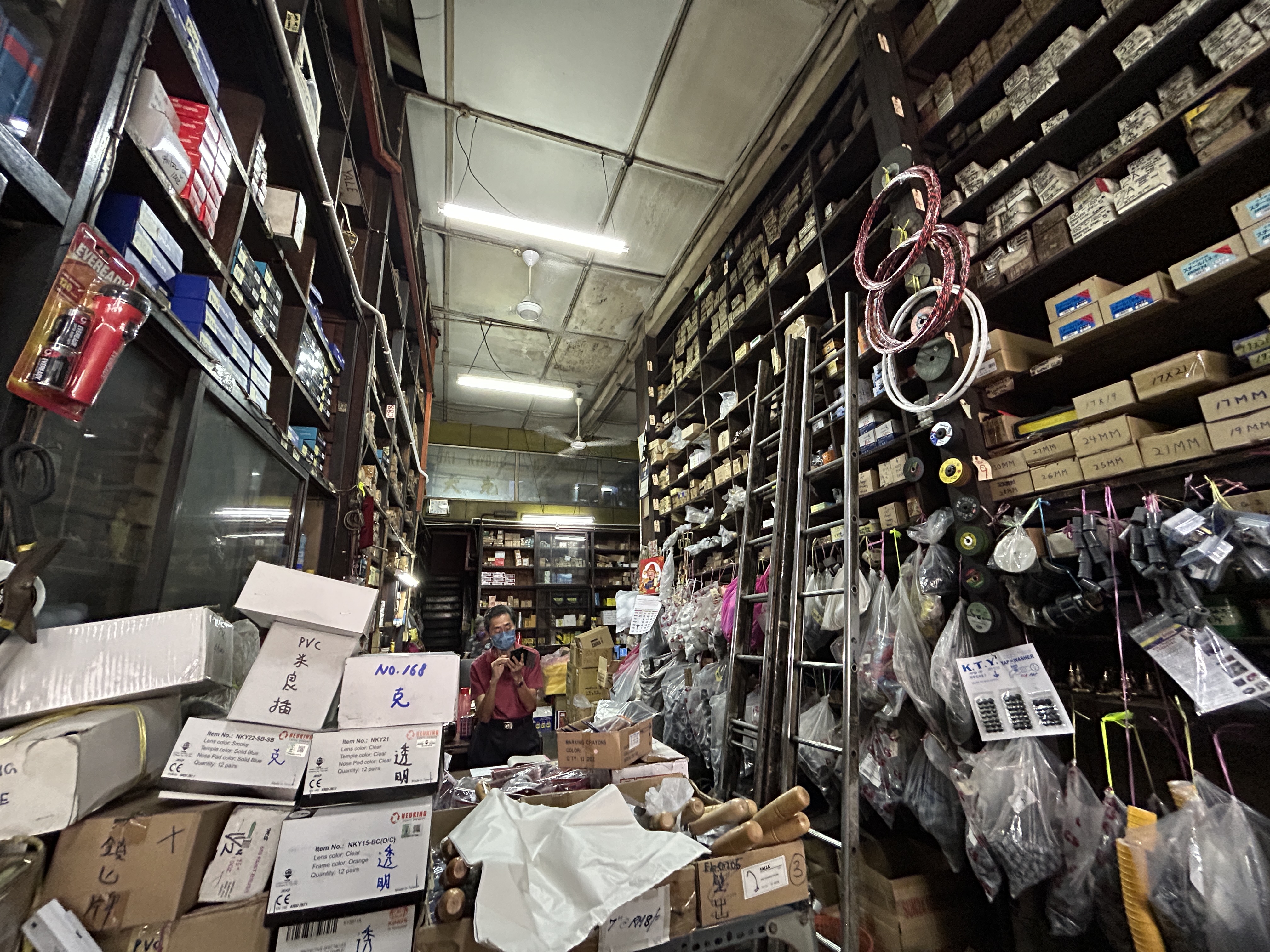
On the first floor of this shophouse is where 71-year-old Liew Fui Tse has spent almost half a century managing Tai Kwong’s accounts.
Arriving from Muar as a young woman in the 1970s, she would take the bus to work and stop at Foch Avenue – later renamed Jalan Tun Tan Cheng Lock after the founding president of the Malayan Chinese Association.
At lunch, she would walk across that busy thoroughfare to Jalan Petaling for fried noodles, fried meehoon and a pork offals congee so popular it inspired her own dreams to start a similar stall. There was no green roof to take refuge under or designer knockoff vendor to fend off back then. Instead, Aunty Liew remembers the street being an outdoor food court of sorts, where hawkers would wheel out push carts of food that had been cooked at home.
And it was truly Chinatown in every sense of the word.
“There were only Chinese people here in the past. All the hawkers here were Chinese and they all spoke Cantonese.”
Tapioca factory street
The story of how Jalan Petaling came to be lies in its name. Not its romanised name, but its Chinese moniker – 茨广街 (shu chong gai), ie. tapioca factory street.
In the 1870s when Yap Ah Loy was the Kapitan of Kuala Lumpur, among his many business ventures was a tapioca farm on the site of where Padang Merdeka now is. Some of that tapioca was brought to a tapioca flour mill on this street and that is where it got the name.
How this part of Kuala Lumpur became Chinatown dates back even further.
In 1857, Klang Valley governor Raja Abdullah hired Hakka Chinese labourers to explore tin mines in Ampang, Selangor. Among the pioneer settlers were two men named Hiu Siew and Yap Sze, who set up a grocery store and go-down near where the Gombak and Klang rivers converge.
From there, the first Chinese settlement – think long wooden shacks with thatched roofs – began taking shape. Within these shacks were homes, shops, temples and a large market that served as a hub for legal – as well as nefarious – economic activity. British colonial officers later dubbed this area the “Chinese Quarter”.
When the Selangor Civil War decimated most of these structures, Kapitan Yap Ah Loy began rebuilding the settlement into less flammable brick shophouses. The old market was transformed into an orderly market square of Neoclassical, Utilitarian and Art Deco buildings. He also established tin mining, brick kiln and tapioca businesses. These developments attracted more Chinese migrants to work and eventually settle here.
Changing demographics
This area may have begun as Chinatown, but it is far more diverse today.
Over the past 50 years, Aunty Liew has seen more and more heritage businesses move out. Many of the food stalls she used to frequent are no longer around. And Tai Kwong is probably the last hardware store in the vicinity.
A few streets away from the store is Jalan Tun Tan Siew Sin, formerly Jalan Silang before it was renamed after Malaysia’s longest serving finance minister, who also happens to be Tan Cheng Lock’s son. Here was once where Aunty Liew came for towels and textiles.
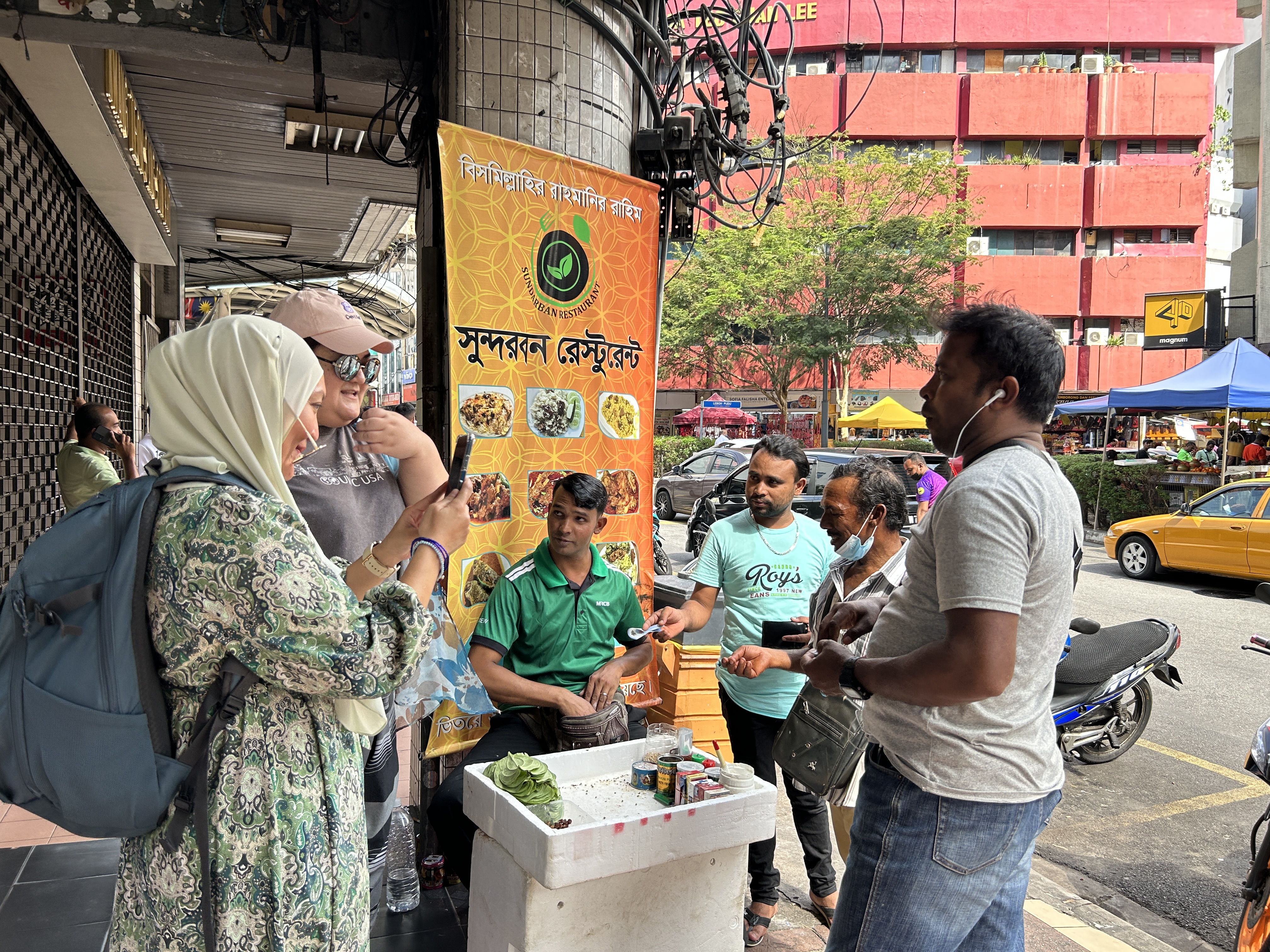
Today, it is where Bangladeshi and Nepali migrant workers – the backbone of Malaysia’s construction industry – come and buy a thick, colourful blanket called kambal to bring home where the weather is more temperate.
Here is also where Bangladeshi men – and it is mostly men – come to mingle, buy internet data for their mobile phones, get groceries, remit money home and chew sirih (betel) leaves.
Aunty Liew recalls how bustling Kompleks Kota Raya was in the 1970s, waving her hands in the air as she conjured up images of fashionable crowds visiting hair salons, beauty parlours and sundry shops there. But as shops moved out one by one to glitzier areas like Bukit Bintang, the imposing six-storey building gradually became forgotten.
I struggle to imagine it when people tell me Kota Raya was the Suria KLCC or Pavilion KL of yore. Today, the mall still looks dated but has transformed into a surprising hub for Filipino culture. It is especially vibrant on weekends when Filipino migrant workers have time off from work.
Grocery shelves here are typically stocked with canned sisig (a Filipino pork dish), banana ketchup and soaps that claim to whiten the skin. Clothes and shoe shops are interspersed between food stalls offering balut (fertilised egg), halo halo (a mix of all your favourite desserts in one large mug), lechon (roast pork) and of course, the chance to karaoke alongside your meal.

Cool and contradictory
Demographics is not the only thing about the area that has changed. During my formative years, Jalan Petaling and its surrounding areas were generally deemed less than desirable. I vividly recall walking past dishevelled men sleeping in front of shuttered shops as my mother warned me about pickpockets and bak fen zhai (cocaine addicts).
It was perhaps the government’s River of Life project that reignited interest in the area. Launched in 2011, some RM4.4 billion has been spent on cleaning up the polluted Klang and Gombak rivers, and on beautifying the river banks.
In 2019, the once-forgotten Kwai Chai Hong was rejuvenated into a lane for photogenic murals, trendy food offerings, festivals and public art installations. The previously abandoned Rex theatre building has also been reimagined as an exciting creative community hub called REXKL. Last year, the 93-year-old Lee Rubber building reopened as a trendy hotel with its Art Deco façade intact.
All these developments (re-developments, really) have transformed the area into an attraction for urbanites and tourists. A place I once knew for its crime, cocaine and chee cheong fun was actually cool now.
Full of contradictions as well, that is.
Rising out quite literally from behind these regeneration efforts is the unmistakable 118-storey silhouette of the Merdeka 118 tower, soon to be the tallest building in the country and the second-tallest structure in the world.
All this while former landmarks like Bangunan Cahaya Suria appear shadows of their former selves. Built by the government back in 1974, it is perhaps most well-known for having a public dental clinic that offered free dental check-ups. Today the dental clinic is gone and the rest of the 18-floor tower appears sparsely tenanted with a considerable Rohingya Myanmarese presence.
Sinar Kota stands next door to it. Built in 1984 by the government to spur Bumiputera businesses, today only a portion of the mall is tenanted to hypermarket chain Mydin while the rest is poorly maintained.
And then there is Wisma Yakin, a building rich in cultural significance as a long-time symbol of Malay business prowess. Like Cahaya Suria and Sinar Kota, it also appears dated and quiet.
Over time, different waves of migrants have come through this part of Kuala Lumpur. Crowds have come and gone and then come again. Buildings have had their fortunes rise and fall.
But what has endured about this place is it continues to be a harbour for migrant communities to live, work and find belonging.
As I have rediscovered the Jalan Petaling area as an adult, I find myself wondering how we can pay homage to those who built the place while also honouring the many layers of life it has played host to. By changing street names? Or by maintaining them?
78 and thriving
Back at Tai Kwong, I was surprised to learn that business is better today than it has ever been in its 78-year history. This is despite it having just one store and not much of an online presence, in an age of Mr DIY and Shopee no less.
It is a muggy weekday afternoon and customers stream in and out asking for nails, spanners, hammers and saws. Aunty Liew is too busy to entertain my questions and shoos me away. The rest of the staff – most of whom are elderly and have been here for decades – juggle between answering phone calls, tending to in-person customers and manually writing down every bill.
Only Lee Zhan Wei, the store’s fast-talking, 30-year-old third-generation co-owner, has some attention to spare. Growing up, he spent a lot of time here while his father and grandfather ran the business. Sometimes he sat inside the shop and did his homework. Oother times he would drop by after school, ask his dad for money and then run off with his friends.
As he gave me a tour of all four storeys, Zhan Wei began to name every tool and its use. Some were European-made, heavy and expensive but practically obsolete. Remnants of a time and world system before hyper affordable China-made goods dominated the market place. He seemed prepared to preserve things as they were, dismissing my suggestions to replace the handbuilt shelves or rickety wooden staircases.
Tai Kwong’s current suite of clientele is perhaps reflective of both the changing demographics of the area as well as of the entire construction industry.
Most, if not all, are migrant workers. And while they once sold to local construction firms, their best customers today are walk-ins who, well, walk in and pay in full for what they buy. This means they can worry less about delayed payment terms usually associated with big corporate accounts.
It has been five years since he joined the family business, and one of the things Zhan Wei has learned is to tailor the store’s offerings to his customers’ needs. He makes an effort to be on a first-name basis with his best customers, who tend to WhatsApp through orders for truckloads of tools and materials to be delivered to different construction sites.
Instead of social media marketing, he prefers to invest in building up a solid reputation with his clients. And bank on them to tell their colleagues in the construction business about his store. Good, ol’ fashioned word of mouth.
As for Aunty Liew, she is glad that Tai Kwong has managed to ride the waves of change for so long.
She still manages the books but is working on passing on the baton to her daughter Nico, who recently began working in the accounts department.
As Nico and Zhan Wei tell me their future plans, my mind’s eye imagines a montage where movement and change swirl around Tai Kwong in a whirlwind.
All while its canary yellow store remains planted front and centre of the frame, permanently carved into the Kuala Lumpur cityscape.
The author would like to thank Aunty Liew Fui Tse, Lee Zhan Wei, Nico and the Tai Kwong hardware shop team for sharing their stories. Big thanks also to Adriana Nordin Manan, Badrul Hisham Ismail and the Hitting The Pavement: Riwayat 3 Tun writing cohort for all the feedback and fun times. Research on the history of Kuala Lumpur was done at the Sin Sze Si Ya Temple Pioneers of Kuala Lumpur Museum along Jalan Tun H S Lee.
 ANNABELLE LEE