How UNFPA in Malaysia is supporting efforts to empower grassroots communities to make informed choices about their fertility, families and future.
Note: This article was published on the UNFPA in Malaysia website here.
By Annabelle Lee
The afternoon heat brought droplets of moisture to folds in the skin as restless children ran about, squealing for attention.
That did not seem to bother 17-year-old Riah*, whose attention was locked in on the woman up front talking about sex, reproduction and family planning.
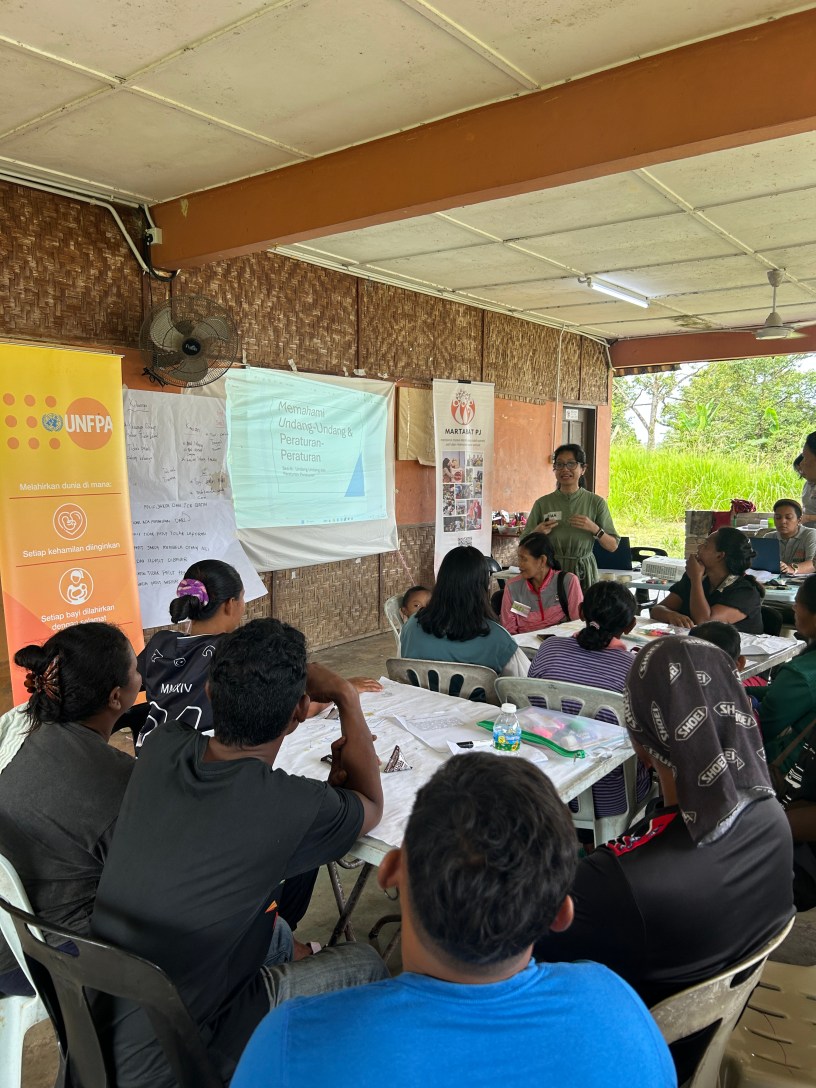
At the next table were her mother and grandmother. All three generations of Jakun Orang Asli women were part of a two-day programme on sexual and reproductive health and rights (SRHR) and gender-based violence (GBV) held at the village’s semi-open air community hall.
Riah did not even live in the village anymore. She had travelled to her hometown when she learned that civil society organisation Martabat Untuk Semua Petaling Jaya was bringing the programme into the village.
For the rest of the year, she lived with her husband and toddler son half an hour away.
Five months pregnant with her second child, Riah exclaimed at how much she enjoyed learning – for the first time – about topics that were so intimately relevant to her life as a young woman and young mother.
She compared it to how miserable she had been in school, a key factor that had led her to drop out of Form 1 at 13 years old. While being pregnant and married as an adolescent was uncommon in her community, not finishing secondary school was not.
The Orang Asli are indigenous populations in Peninsular Malaysia and make up about 0.7 percent of the population. According to data from the Department of Orang Asli Development (JAKOA), the proportion of students who finished primary school but did not transition to secondary school has been hovering around 20 percent in recent years. Of the 3,812 Orang Asli students who finished Standard 6 in 2019, only 2,963 enrolled into Form 1 the following year. This represents a discrepancy of 849 students or about 22.7 percent. The reasons for this are multidimensional, and include inequality, discrimination, bullying, distance and a lack of trust in the schooling system.
Back at the village, all participants said they did not complete secondary school and like Riah, the programme was their first encounter with topics about SRHR and GBV. Many needed assistance just to understand a brief survey on their pre-existing knowledge on the subject matter.
To attend the programme, participants had to make the tough choice to leave their vegetable crops at a nearby organic farm untended for two days. A choice that was made somewhat easier by the fact that the fair-trade social enterprise that operated the farm was a co-organiser of the event.
Dignity for all
Led by prominent human rights activist and former parliamentarian Maria Chin Abdullah, Martabat Untuk Semua Petaling Jaya or Martabat PJ is a civil society organisation that has been working with communities towards eliminating poverty, GBV, and inadequate access to SRHR since 2018. Martabat untuk semua means “dignity for all” in Bahasa Malaysia.
Supported by UNFPA in Malaysia, Martabat PJ’s team of experts delivered a literacy programme on SRHR and GBV to communities from three groups – the Orang Asli, persons with disabilities, and the socio-economically disadvantaged – in the Klang Valley, Pahang and Kedah.
That afternoon at the community hall, the woman whom Riah was listening to was Dato’ Dr Narimah Awin – the former chairperson of the National Population and Family Development Board (LPPKN), a government body tasked with improving reproductive health and population resilience in the country.
A former SRHR advisor to UNFPA in Malaysia, Dr Narimah was previously the World Health Organization (WHO) regional advisor for maternal and reproductive health for the Western Pacific and Southeast Asia regions. Prior to that, the medical doctor was the director of family health development at the Malaysian Ministry of Health.
Apart from Dr Narimah’s session on the basics of SRHR, participants also heard from lawyer and human rights advocate Azira Aziz.
Azira had a rapt audience as she spoke on rape, GBV, technology-facilitated gender-based violence (TFGBV), laws like the Anti-Sexual Harassment Act 2022, and how participants could access affordable legal services.
The literacy programme further allowed participants to reframe gender clichés and gender roles, learn about sexually transmitted infections, map out where to access essential sexual and reproductive health services, and recognise the importance of gender equality – all facilitated in an interactive, activity-rich manner by human rights activist Manohara Subramaniam and licensed counsellor Haslinah Yacob.
Running the programme in the village meant being able to reach those who simply could not leave home to attend it elsewhere. In the mornings, mothers would walk out from their homes to the community hall with all their children in tow. Having childcare and meals provided gave parents, especially mothers, the rare chance to shift their focus to equipping themselves.
Reaching those furthest-behind first
Advancing SRHR, ending GBV and ensuring no one is left behind is at the core of UNFPA in Malaysia’s work.
In the past 53 years that the United Nations sexual and reproductive health agency has been in Malaysia, the country has progressed leaps and bounds in its maternal health indicators and literacy rates. Still, left-behind populations like the Orang Asli remain.
Some comprehensive sexuality education (CSE) is integrated into the national school curriculum, and although awareness of the need for CSE is growing, general understanding of SRHR and GBV is low. The use of modern contraception methods in Malaysia is relatively low, 34.3 percent when last surveyed in 2014 while unmet need for family planning is relatively high at 26.7 percent. Patriarchal attitudes are deeply ingrained, as are rigid definitions of masculinity and femininity.
Efforts to address these knowledge gaps, social attitudes and cultural norms must take place in all communities.
Which is why, on top of advocacy efforts in the area of policy dialogues and research reports, UNFPA partnered with Martabat PJ to deliver this SRHR and GBV literacy programme to furthest-behind communities in an accurate, rights-based and contextualised manner. As these communities often face the biggest hurdles to accessing SRHR and GBV services, emphasis was placed on explaining existing laws, detailing the legal rights of GBV survivors and outlining pathways to access the relevant health and legal services.
In the second phase following the conclusion of the programmes, Martabat PJ will run another round of sessions with the same Orang Asli, persons with disabilities, and socio-economically disadvantaged groups, this time to train SRHR advocates identified from within them. The goal is to develop grassroots champions who will further drive transformation in their communities.
Also in the works is a comprehensive resource guide. Intended as an authoritative piece of reference material for those working in the area of SRHR and GBV prevention, the publicly accessible guide will detail all relevant definitions, concepts, principles, rights, laws, and approaches, plus provide a step-by-step guidance on how critical services can be accessed. Informed by the literacy programme, the guide will further note the challenges faced by marginalised communities in accessing rights and services.
Additionally, Martabat PJ will develop a training manual for trainers so the literacy programme can be expanded to even more communities. Through this integrated approach of programmes, training and the development of resources, UNFPA is supporting transformation where it is needed most – at the grassroots level.
As Malaysia adapts to an ageing population amidst concerns over birth rates, UNFPA believes that the path forward must be guided by a commitment to reproductive agency – the capacity to exercise informed, empowered decision-making over one’s reproduction.
Reproductive agency is underpinned by a deep understanding of SRHR, having access to services and resources, and protection from GBV. Ensuring rights and choices for all segments of the population will allow the fruits of population resilience efforts to be enjoyed by everyone.
Back at the community hall that afternoon, Riah shared how she could not wait to give birth and be done with the subsequent customary one-month confinement period.
She dreamed of finally getting her driver’s license, something which she saw as a pathway to a better-paying job and more financial stability for her family.
“Even though I am married and have a family, there is so much I do not know. I have learned so many things because Martabat PJ came here,” she said.
*Name changed for privacy and protection

